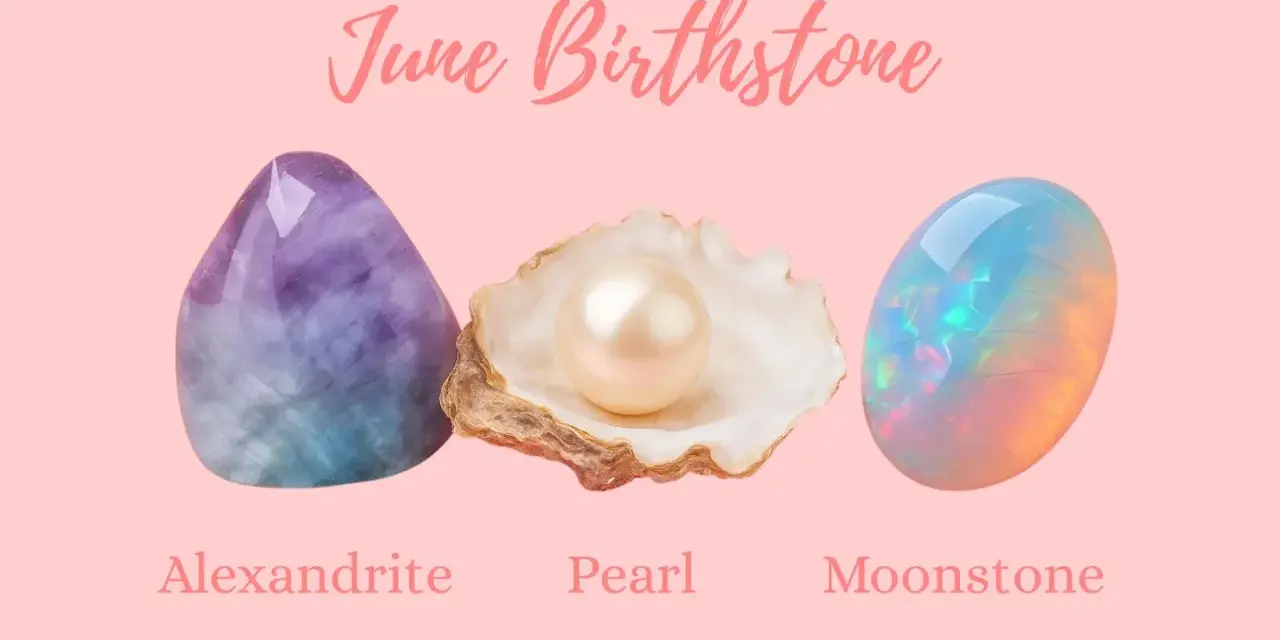
The answer to what is June's birthstone is not a single gem but a trio: pearl, moonstone and alexandrite. That matters because each one fits a different kind of wearer, from someone who wants a timeless classic to someone who prefers a rare, colour-changing stone. In this guide, I break down what each gem is, how they differ in wearability and style, and how to choose the one that actually makes sense for the jewellery you have in mind.
June gives you three distinct birthstones, each with a different job
- Pearl is the classic June stone: elegant, organic and easy to recognise.
- Moonstone brings a soft glow thanks to its adularescence, which is the floating sheen across the gem.
- Alexandrite is the rare showpiece, famous for shifting from green in daylight to red or purplish red in warm light.
- June is one of only three months with three birthstones, so you can choose by style, budget and durability rather than by symbolism alone.
- For everyday wear, the stone you choose matters less than how it is set, cleaned and stored.
Why June has three birthstones
June is unusual in birthstone charts because it offers real choice. GIA notes that it is one of only three months with three birthstones, which is why June feels less like a fixed answer and more like a small jewellery wardrobe. In practice, that variety is useful: pearl gives you a classic look, moonstone adds a softer contemporary feel, and alexandrite delivers rarity and drama.I like June for exactly that reason. Instead of forcing one gem to do every job, the month gives you options that cover different tastes, different budgets and very different levels of durability. Once you understand that, the rest of the decision becomes much clearer.
That flexibility is the real story behind June, and it makes the individual stones worth looking at on their own.
Pearl, the classic June birthstone
Pearl is the June birthstone most people recognise immediately. It is an organic gem, which means it forms inside a living mollusc rather than growing as a crystal in rock. That alone sets it apart from most other gemstones, and it also explains why pearls have such a soft, elegant lustre that looks different from faceted stones.
Most pearls sold today are cultured, which is normal, not lesser. The value still comes from visible quality factors such as lustre, surface quality, shape and size. In styling terms, pearl is the most versatile of the three June stones if you want something refined rather than flashy. I usually think of it as the safest choice for a gift, especially when the recipient prefers subtle jewellery.
Pearls also carry a long history of associations with purity, simplicity and bridal jewellery. That makes them a natural fit for necklaces, stud earrings and keepsake pieces. I would be more cautious with pearl rings, especially for someone who wears jewellery hard, because pearls are softer than most people realise.
If pearl is the classic answer, moonstone is the one that gives June a more romantic, airy mood.
Moonstone, the soft glow option
Moonstone is the June birthstone for anyone who loves light rather than sparkle. Its signature effect is called adularescence, which is the billowing sheen that seems to move under the surface of the stone. That glow comes from the way light scatters between microscopic layers in the feldspar structure. It is a technical effect, but the result is simple: moonstone looks almost atmospheric.
Moonstone is usually cut as a cabochon, which means a smooth, rounded surface rather than a faceted one. That cut is not a style gimmick. It is the best way to show the gem's glow. You will also find moonstone in colours ranging from colourless and white to peach, grey and green, although the most prized stones often show a clean body colour with a blue sheen.
From a practical point of view, I tend to recommend moonstone for pendants, earrings and protective settings. It sits around 6 to 6.5 on the Mohs scale, so it is harder than pearl but still not a stone I would treat casually. A hard knock can damage it because moonstone has cleavage, which is a structural weakness that makes it more prone to splitting along certain planes.
For a completely different kind of June stone, alexandrite brings rarity and spectacle into the conversation.
Alexandrite, the rare colour-changing option
Alexandrite is the most dramatic June birthstone by a wide margin. In daylight it can look bluish green, then shift toward red or purplish red under incandescent light. That colour change is what makes the gem famous, and it is also what makes fine material so desirable. GIA describes it as a rare colour-change variety of chrysoberyl, and that rarity is not marketing fluff. It is genuinely hard to find in top quality.
This is the stone for someone who wants something unusual and is comfortable paying for it. Most fashioned alexandrites weigh less than 1 carat, and fine stones above 5 carats become very expensive. If you see a gem that claims a strong colour change at a suspiciously low price, I would be careful. In many cases, it is synthetic or a simulant rather than natural alexandrite.
Durability is one of the reasons jewellers like it for rings. Alexandrite is hard, tough and suitable for daily wear, which makes it the most practical June birthstone for a ring if budget is not the main constraint. For buying, I would want either a trusted jeweller's guidance or a lab report, especially for a significant purchase.
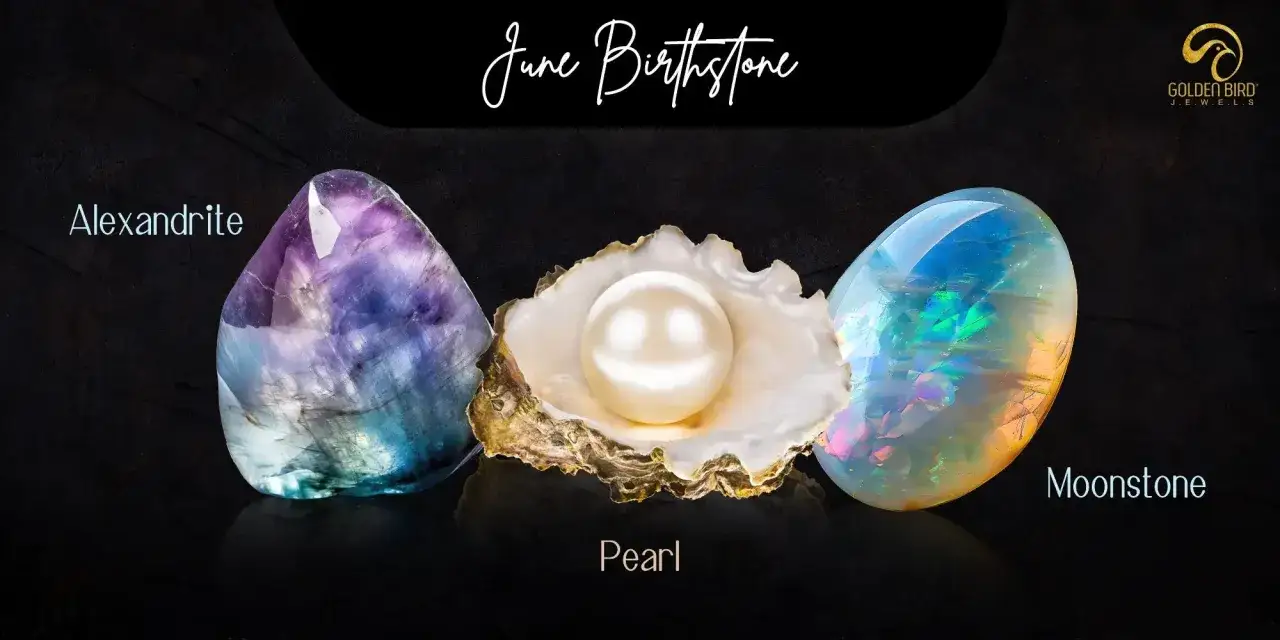
How the three June birthstones compare at a glance
| Stone | Look | Durability | Best use | What to watch for |
|---|---|---|---|---|
| Pearl | Soft lustre, classic and understated | Very soft, around 2.5 Mohs | Necklaces, studs, bridal pieces | Chemicals, scratches, ultrasonic and steam cleaning |
| Moonstone | Milky glow with adularescence | Moderate, about 6 to 6.5 Mohs | Pendants, earrings, occasional rings | Knocks, cleavage, heat, ultrasonic and steam cleaning |
| Alexandrite | Colour change from green to red | High, about 8.5 Mohs | Rings and heirloom pieces | Rarity, lab reports, synthetic lookalikes |
The simplest way to read that table is this: pearl is style-first, moonstone is glow-first and alexandrite is rarity-first. That makes the next step less about gemstone facts and more about matching the stone to the person who will actually wear it.
How to choose the right one for the wearer
The best June birthstone depends on how the jewellery will live in real life. If it is for someone who wears a necklace or earrings most days and likes a polished, classic look, pearl is the most forgiving choice. If the wearer prefers softer, modern pieces with a little visual movement, moonstone usually feels fresher and less formal.
If you are choosing for a ring, I would think differently. Alexandrite is the most durable and the most ring-friendly of the three, while moonstone can work well only if the setting protects it. Pearl rings can be beautiful, but they make more sense as occasional pieces than as something to wear without thinking.
There is also a budget angle that people do not always say out loud. Pearl and moonstone usually give you more visual impact for the money, while alexandrite can move into serious collector territory very quickly. If the goal is a thoughtful gift rather than a rare gem, the first two are often the smarter buy. Once you settle on the right stone, the care routine is what keeps it looking the way you expect.
Caring for June birthstone jewellery
For care, I tend to follow the simplest rule first: use the gentlest method that will still clean the piece properly. GIA's guidance is clear enough to be practical. Pearls should never go in ultrasonic or steam cleaners, and they should be kept away from perfume, hairspray, cosmetics and even perspiration as much as possible. A soft cloth after wear does more good than people think.
Moonstone also prefers a light touch. Warm soapy water is the safest approach, and ultrasonic or steam cleaning should be avoided. I would also store moonstone separately, because it can scratch more easily than harder gems and it does not appreciate knocks or sudden temperature changes.
Alexandrite is the least fussy of the three. Warm soapy water is safe, and the stone is durable enough for more regular wear. That said, I still stay cautious with antique jewellery, fracture-filled stones or settings that mix several gem types, because the weakest component in the piece should decide the cleaning method. In mixed-gem jewellery, I would always choose the safest option for the most delicate stone.
Once the care routine is sorted, the last question is less technical and more personal: which June stone actually feels right as a gift or a keepsake?
The best June birthstone is the one that matches real wear
If I had to narrow it down quickly, I would put it like this: pearl is the most timeless, moonstone is the most softly expressive and alexandrite is the most extraordinary. None of them is a bad answer. The better choice is the one that fits the wearer’s style, routine and tolerance for maintenance.
For most people, pearl is the easiest entry point, moonstone is the most distinctive everyday option and alexandrite is the one to choose when rarity matters as much as beauty. That is why June stands out among birthstone months: it gives you a proper range rather than a single default gem. If you use that range well, you end up with jewellery that feels more personal and far more wearable.